


What changes when we use AI in advertising?
In AI-generated advertisements, image rights depend on how the character was created. If the character is based on a real actor, their likeness must be covered by clear usage agreements. If the character is generated entirely with AI, there are no image rights belonging to a real person, but platform licensing, commercial usage rights, asset confidentiality, and avoiding similarities to identifiable individuals remain important considerations.
For brands, AI opens up enormous possibilities in video production: we can create characters, worlds, environments, and situations that would have been difficult, expensive, or slow to produce using traditional methods. But along with these possibilities come new questions: who owns the character’s image? What happens if we start from the face of a real actor? Can we commercially use a character generated from a prompt?
At Parcfilm, we treat AI production as an extension of traditional video production. We do not focus only on how spectacular the final image is, but also on the process behind it: casting, rights, licenses, confidentiality, visual consistency, and client protection.
1. When the AI character is based on a real actor
The first situation is the closest to traditional production: real casting, real people, real faces. Actors are photographed or filmed, and their image is used as a reference for AI generation, based on a character sheet – see the next chapter. These actors sign copyright and usage agreements in accordance with the client’s requirements regarding territory, media channels, and usage period.
In a traditional shoot, the actor appears in the footage captured on set. In an AI workflow, their image becomes the foundation of a digital character that can be animated, modified, relit, or integrated into new contexts.
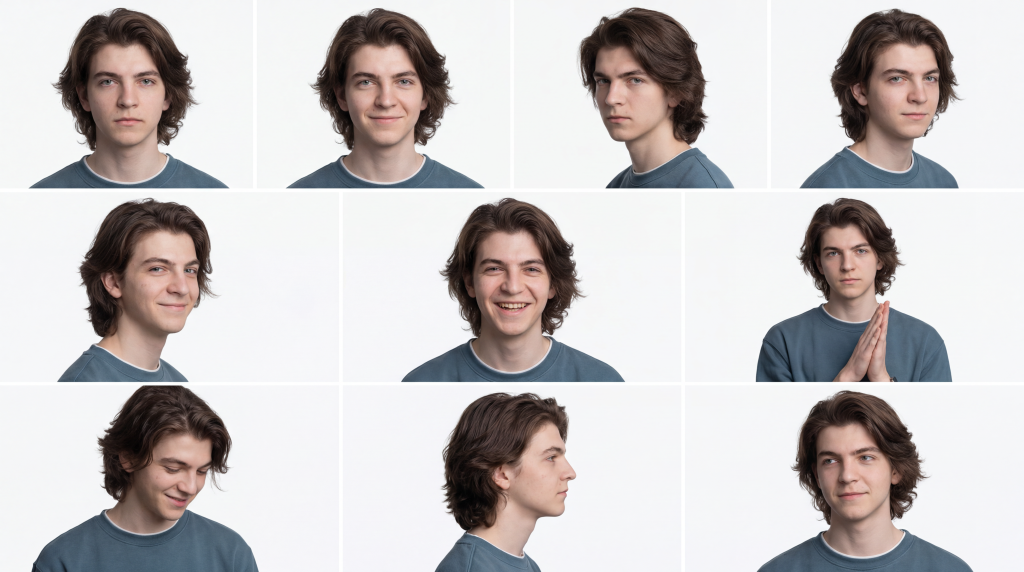
A concrete example is the Meggle project, where we used a real photograph taken on set as the starting point for an AI-generated social media clip. The photograph was not the final result, but the initial reference for a larger workflow. We created character sheets for the father and son, including expressions, profiles, poses, and different attitudes, so that the generated characters would remain consistent with both the actors and the atmosphere of the live-action shoot.
This is where the difference between simple AI generation and controlled AI production becomes apparent. It is not just about creating a beautiful image, but about preserving the visual identity of a character from one frame to the next.
2. When the character is generated entirely with AI
The second situation is different: there is no real actor. We only have a casting brief provided by the client. The character is created directly through prompts and refined through multiple iterations until it becomes suitable for the brand. In practice, it is a casting process using multiple AI generations that match the brief until we find a version we like 🙂
In this case, there is no real person who owns image rights to that face. The character is not “someone.” It is a synthetic asset generated digitally.
But that does not mean there are no legal or commercial questions. For a brand, commercial rights to the output, AI platform terms, asset confidentiality, and the risk that the character resembles an identifiable real person are all important considerations.
This is where the difference between a standard account and an Enterprise license becomes extremely important.
At Parcfilm, for commercial AI projects, we work with Enterprise licenses rather than free tools or personal accounts used ad hoc. An Enterprise license provides a clearer contractual framework for commercial usage and, under certain conditions, offers protection worth millions of euros against certain intellectual property or image rights claims.
There is another very important aspect: an Enterprise license prevents our materials from being used to train the AI platform. In other words, the images, references, character sheets, start frames, end frames, or other assets uploaded and generated within our projects do not become part of the tool’s training database, eliminating the risk that they could later be absorbed by the system and appear, directly or indirectly, in productions generated by other users.
3. The character sheet: the new key asset in AI production
In AI video production, the character sheet is one of the most important working tools.
An AI character sheet is a set of images and visual guidelines that help maintain consistency for a character across multiple frames, expressions, or situations. It can include the character’s face from different angles, various expressions, body positions, costume details, proportions, and guidance regarding lighting or visual style.
If the character is based on a real actor, the character sheet becomes a digital extension of that person’s likeness. If the character is generated entirely with AI, the character sheet remains equally important, but for a different reason: it helps build an original and consistent visual identity.

Without this stage, AI can generate spectacular images that lack consistency. A character may appear to be a different person from one frame to the next: different age, different facial structure, different proportions, different energy.

4. The grey area: when an AI character resembles a real person
An AI-generated character has no image rights of its own because it is not a real person. But if that character resembles a real person too closely, especially a public figure, the issue is no longer purely technological. It becomes a matter of public perception.
If a prompt asks for “a famous actor, but not exactly him” or “a well-known influencer, slightly altered,” the problem does not disappear simply because the image is generated. If the result is recognizable, discussions may arise around likeness rights, image rights, personality rights, or unauthorized association with a real person.
For a brand, it is not enough to say, “We didn’t use that person’s photograph.” If the final result appears to represent that person, the association can become problematic.
For this reason, in our workflow we avoid prompts that attempt to imitate actors, influencers, or public figures. We prefer to build original characters, approved by the client, with their own visual identity.
A good AI character should not be a copy of someone. It should be coherent, believable, and suitable for the brand.
5. Why a professional workflow and traditional production experience still matter
Today, almost anyone can generate an image with AI. But an advertising campaign is not just about a successful image. It involves concept development, casting, rights, licensing, approvals, visual consistency, creative control, documentation, and responsibility towards the client through a contract.
For Parcfilm, AI production is not a shortcut but an extension of traditional video production. We use the same principles that matter on a real set: strong casting, lighting, styling, continuity, directing, post-production, and careful attention to rights.
In AI projects, the producer’s role remains just as important. The production company ensures that the traditional steps of any video production are preserved – kick-off meetings, pre-PPM meetings, PPM meetings. In each meeting, we cover every chapter of the project, from shot lists and shooting boards to locations, casting, costumes, props, and music. All of this creates an additional layer of control, and that is what makes the difference between an experiment and an experienced producer.
Frequently Asked Questions About Image Rights in AI Production
Can you use a real actor’s image for AI generation?
Yes, but there must be written consent covering this type of usage. AI generation should be treated as a separate deliverable and included in the contract.
Does an AI-generated character have image rights?
Not in the traditional sense, because it is not a real person. However, the AI platform license, commercial usage rights, and the risk of resemblance to an identifiable real person must all be reviewed.
What is an AI character sheet?
An AI character sheet is a collection of images and references used to maintain consistency for a character across multiple frames. It may include expressions, angles, poses, costume details, proportions, and guidance regarding lighting or visual style.
Why does an Enterprise license matter for AI?
An Enterprise license provides a safer commercial framework for professional projects and legal coverage worth millions of euros for certain types of claims. In our case, an important advantage is that uploaded and generated materials are not used to train the AI tool, which helps protect assets created for clients.
Conclusion
AI is changing the way we produce advertising, but it does not eliminate the industry’s fundamental questions: who appears in the image, who approved its use, where can it be distributed, for how long, and under what conditions?
When working with real actors, image rights must be handled carefully and clearly defined in contracts, because an actor’s likeness can become the foundation of a digital character. When working with fully AI-generated characters, attention must be paid to platform licensing, commercial usage rights, asset confidentiality, and avoiding similarities to real individuals.
For brands, the advantage of a professional workflow is not only visual quality. It is the assurance that the generated imagery is supported by a process: casting, consent, Enterprise licensing, creative control, confidentiality, and documentation.