


It happens often: we are shooting a TV commercial, but besides the main spot, the client also wants additional content for social media. One video, two, or nine — that’s not really the issue. The problem is that a shooting day only has 12 hours, and once those are over, the crew enters the so-called “overtime.” And when you have around 50 people on set, overtime quickly becomes very expensive.
Because of this, there is often not enough time left to shoot dedicated social media content, or it becomes a huge source of pressure for the director and the entire crew.
In theory, it sounds simple: “let’s also shoot a few short clips for social media.” In practice, each of these pieces of content means setup time, lighting, blocking, costumes, make-up, food styling, props, additional shots, multiple takes, approvals, and sometimes complete set resets. And when we are talking about a video production involving food styling, things become even more complicated, because the product has to look flawless in every single frame.
In the case of this project, the main commercial was a complex shoot, with a lot of attention dedicated to the product, the actors, and the kitchen atmosphere. The client also needed video content for social media, but the shooting time was limited. Before wrapping the set, we decided to test a hybrid approach: using the real production as a base and generating one of the social media videos with AI.
From real production to AI video generation
The idea came up directly on set. We already had the actors, costumes, lighting, campaign energy, and the set itself. Instead of treating AI as a completely separate solution from traditional filming, we realized we could use it as an extension of the video production that had already been created.
We took a reference photograph of the two actors — father and son — sitting back to back in a serious pose, almost “James Bond style,” each holding a mixer in their hands. The idea for the clip was simple and perfectly suited for social media: the two start off looking very serious, as if they are in a dramatic action scene, and then suddenly burst into laughter.
This photograph was not used as the final result, but as a starting point. It became the composition reference for a broader AI video generation workflow.

Building the characters: an essential step in AI video production
One of the most important aspects of an AI video workflow is character consistency. If you want an AI-generated clip to feel connected to the real production, writing a good prompt is not enough. You need clear references, character sheets, expressions, costumes, and consistent poses.
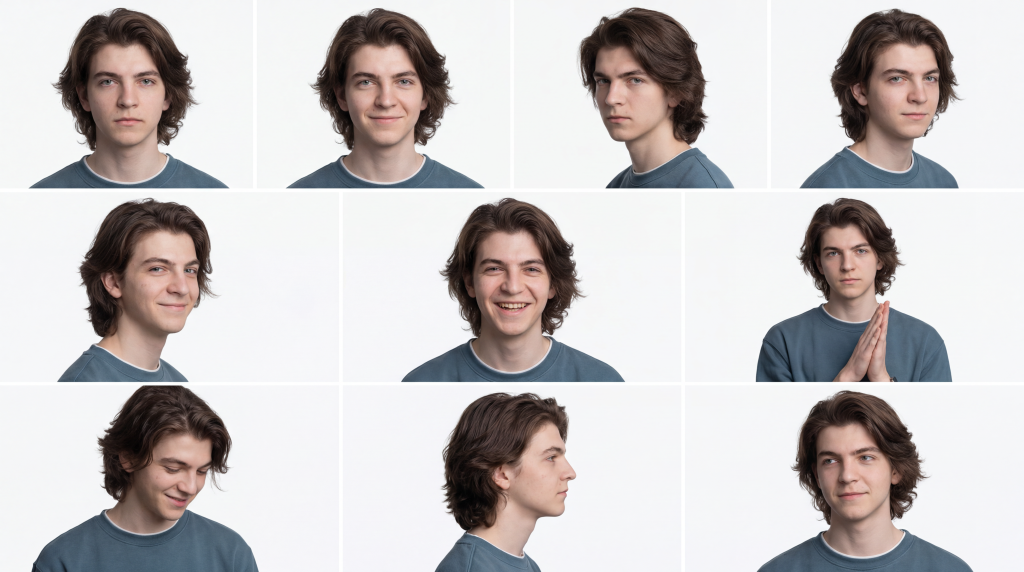
Starting from the photograph taken on set and frames extracted from the main commercial, we created character sheets for both the father and the son. These sheets included different facial expressions, profile angles, attitude variations, and body positions. Essentially, we tried to provide the AI system with as much visual information as possible about who the characters were, how they looked, how they moved, and what kind of relationship existed between them.
This step is essential for any more advanced AI video production. Without it, the result can quickly become generic: faces subtly changing from one frame to another, inconsistent costumes, strange expressions, or movement that does not match the energy of the real production.

Recreating the start frame
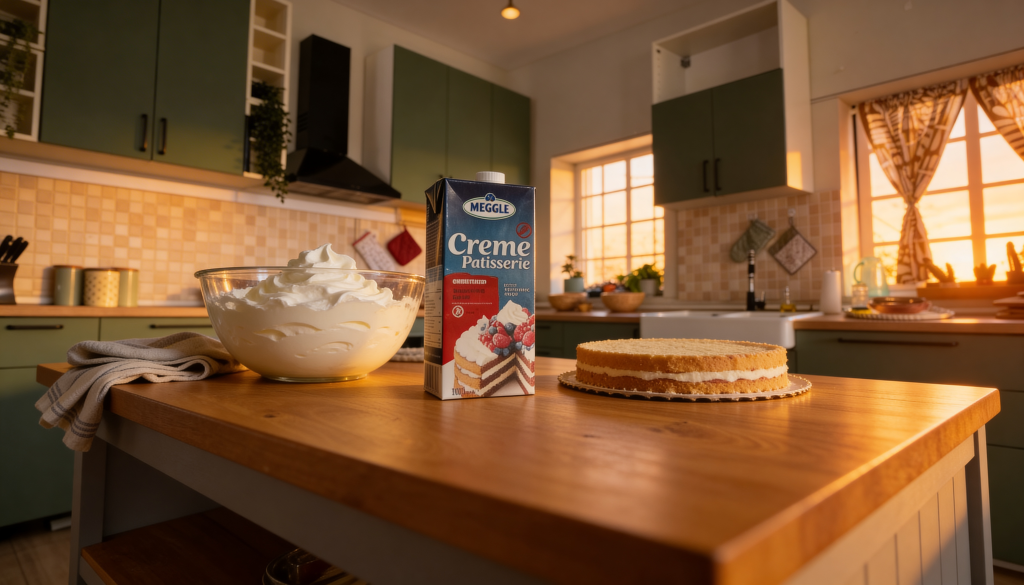
Once we had the reference photograph and the character sheets, we rebuilt the start frame. This means we did not simply take the original photo and animate it, but instead recreated the shot in a controlled way, using elements from the real production: the kitchen set, the warm lighting, the characters’ positioning, the costumes, the objects in their hands, and the overall atmosphere of the main commercial.
The start frame had to look as if it belonged to the same campaign. It needed to preserve the visual language of the original production, while also working as the beginning of a short, comedic clip designed for social media.

The end frame: a clear direction for movement and acting
In AI video generation, a well-defined end frame can make a huge difference. In our case, the clip needed to start from a serious moment and evolve into a relaxed, humorous one. So we also created an end frame that defined the final direction of the sequence: the characters are no longer stuck in the rigid pose of “kitchen secret agents,” but instead move into the playful energy of the clip.
For a social media piece, this type of transformation is important. The first few seconds need to grab attention, while the ending has to deliver a quick, easy-to-understand, and memorable reaction. AI allowed us to explore this micro-storytelling approach without keeping the entire crew on set for another shot, another lighting setup, or another series of takes.
The result: an AI-generated social media clip rooted in real production
The final result is not an AI video disconnected from reality, but a hybrid piece of content. Its foundation comes from the real video production: real actors, real costumes, a real set, and a real visual direction. AI was used to extend this production and create an additional asset at a moment when a traditional shoot was no longer realistic in terms of time and budget.
This feels like one of the most interesting directions for AI video in advertising: not necessarily replacing production, but extending it. There are many situations where brands and agencies need more content than a shooting day can realistically deliver. More variations. More formats. More social media assets. More ideas tested quickly.
In this kind of context, AI video generation can become an extremely useful tool in post-production and in expanding campaigns.
What we learned from this test
The first thing we learned is that AI works much better when it has a solid foundation. The clearer the references are, the more controllable the result becomes. A quick photograph taken on set can become extremely valuable if it is planned from the beginning as a reference for a later AI generation process.
The second thing we learned is that workflow matters enormously. A good AI clip does not come from a clever prompt alone. You need creative direction, careful reference selection, character sheets, control over the start frame and end frame, iterations, and a production mindset. In the end, cinematic language still matters: composition, lighting, acting, rhythm, and continuity.
The third thing we learned is that AI can reduce pressure on set. It does not mean you stop filming. It means you can make smarter decisions about what you shoot, what you prepare as reference material, and what you later expand through AI video generation. For campaigns that require a large amount of social media content, this can become a very efficient solution.
AI video does not mean less production. It means a different kind of production.
We still believe that real production remains essential for many projects. The actors, directing, lighting, set design, product, and on-set atmosphere are not going anywhere. But around this production, a new layer can emerge: one where AI helps generate variations, extensions, shots that would be impossible to film quickly, or additional assets for social media.
For Parcfilm, this is a very interesting territory: classic video production, post-production, and AI generation working together in a shared workflow. We do not treat AI as a shortcut, but as a new tool within the production process. Sometimes we use it for concepts. Other times for visuals. And sometimes, like in this case, to transform an idea born on set into a finished video clip.
For agencies and brands, this approach can mean greater flexibility. Instead of every additional asset automatically requiring extra shooting time, extra crew, and additional costs, some ideas can be developed in a hybrid way: real production where it matters most, and AI video where it can efficiently extend the campaign.
Conclusion
This project was a small test, but a very relevant one for the direction video production is heading toward. A single frame photographed on set, a few character sheets, a start frame, an end frame, and a controlled AI generation process led to a social media clip that still feels connected to the main production.
For us, this is the near future of commercial video production: not a battle between filmmaking and AI, but a collaboration between them. A strong video production can begin on set and continue, intelligently, through AI.
And when the shooting day only has 12 hours, the crew is large, the product is sensitive, and the client still needs one more social media video, this collaboration can make all the difference.